Donnerstag, 17. Oktober 2019

The siege of Freiburg in 1744 (Part 1)


As it was with the battlefield of Simbach, I had the chance to walk over the landscape of the great siege of Freiburg. Therefore I decided to write about it and I hope that this topic is even more exciting for you, as we have the 275th anniversary of the battle (no great attention in Freiburg today nevertheless).


275 years passed since the great siege of Freiburg in autumn 1744. Fortunately this particular siege was viewed as one of the major events of the 1744-campaign in Germany. Therefor a big part of Porges and Rebrachas very detailed work about the War of the Austrian Succession is dedicated to Freiburg[1]. But there are many contemporary accounts printed during the mid 18th century too like “Campagne de Monsieur le Maréchal Duc de Coigny en Allemagne” including many letters and statistics[2]. A really impressive number of maps and other pictures of this and other sieges of Freiburg and the fortress were published in 1988 as one volume of two about the fortress and city[3]. This book is really recommended to get an impression of the actions in 1744.

 A map of the Fort St Pierre on a plaque at the fortress.


I’m so fortunate to look at the remnants of the fortress of Freiburg every morning looking out of the window of our living room. It’s really inspiring for somebody who has an interest in military history. When Alex Burns asked me to write a short guest post I thought about all the remnants of the fortress still visible today and spend a day with my kids walking over the Schlossberg. Besides I was reading a biography about De la Metterie, one of Fredericks closest philosophers and drinking buddies, who suffered a lot from a fever during the siege of Freiburg, where he was present as an intimate of the Duc de Gramont (1689-1745) and as a doctor of the guards[4].

But let us commence more chronical.


The French army followed the Austrian troops under prince Charles of Lorraine and FM Traun when they had to march east to deal with Frederick II attempt to join the war again. The French commanded by Noailles and Coigny tried to attack the Austrians crossing the river Rhine but where thrown back by the Austrian rearguard at Auenheim and Suffelnheim at August 23th 1744. This fail reduced the French plans to catch the Austrian main army. Frederick II justly blamed Coigny and Noailles for their poor leadership at Auenheim. To get one objective for the rest of the campaigning season at least the Austrians began to encircle in September 1744 the city of Freiburg.  Some days later the French commanders send Belle-Isle with significant troops to Rheinfelden, Konstanz and later even to Bregenz to occupy these towns. After some easy success the French were humiliated during their attempt to invade Vorarlberg by local Austrian militias[5].

The militia in Vorderösterreich (Further Austria) were formerly very similar like the strong militia of Vorarlberg and sometimes organized by the same administration. In the 17th century Further Austria assembled the men from 16 to 40 years old in 8 “Landfahnen” (banners). But since 1734 2 “Landfahnen” only remained. One of them, the “Hauensteiner Fahne”, had 906 men in 4 platoons. These relicts of the old militia were commanded by a baron Grammond (not to be mixed up with the French duke of the similar name!), who reinforced the garrison of Freiburg in 1733/34 and was again in Freiburg in 1744[6]. These troops naturally were not fit to fight regulars. But they were used as workers on the fortifications and should stock the old “Linien” (lines of fortifications) all over the Black Forest, when they first were built during the War of the Spanish Succession[7]. Though the militia of Further Austria was weak in numbers compared with the size of the territory (bigger than Wurttemberg for example!), the corporative recruitments were of no great significance too. Further Austria and Vorarlberg together had to put forward 1.500 men for the regular Austrian army in 1744. Most of them were infantry serving in the regiment Brandenburg-Bayreuth (IR 41)[8]  


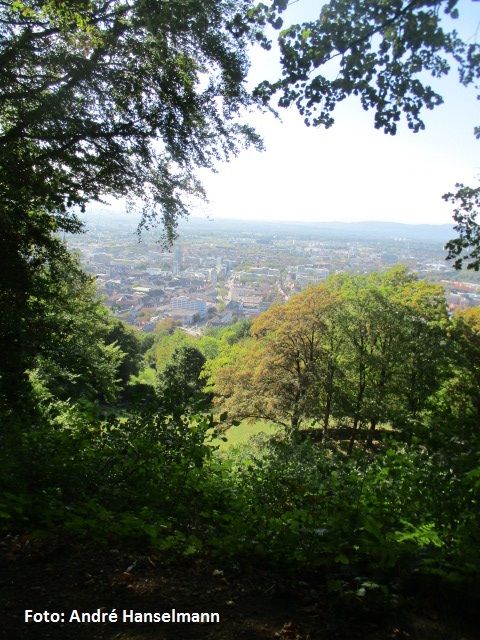
A view from the Fort St Pierre at the town – one can imagine how easily the Austrians could shoot at the French in 1713 from this Position. The Kaiserstuhl lies in the background.

Mittwoch, 16. Oktober 2019

New content

I decided, that I will change the blog slightly.

The blog will report further about our events, but I would like to offer more diversity.

By the way I noticed that most of the questions and all comments were in English. Therefore I will write some posts in English only.

I have to confess that I really much like the style of Jonathan Freitag's blog Palouse Wargaming Journal for example with a wide range of postings about wargaming and historical sides in Europe as well. Especially his studies and analyzes about several battles like Mollwitz are fascinating.

Some of our blogentries have some similarities with Kyle Dalton's excellent blog "British Tars, 1740-1790", which is in his way quiet unique, as it is very narrowly focussed on the period and the main subject.
Occassionally we noticed that not our blogposts about our own events and research for them had the luck to attain the most attention of our readers but entries like our battlefieldwalks at Simbach for example (although the battle had some correlation with our encounter at Übrigshausen in 1743).

As most of you maybe had recognized we added more and more information about the 17th century period, because there is very much to research about that period since we organize an event yearly in the highly interesting open air museum Wackershofen.


But now to something different. I noticed two stones with dates engraved in Freiburg. One example is next to the Schwabentorbrücke.


What happened here in 1609?

The other stone is in the Augustinergasse in the old town of Freiburg. The canonball (?) beneath the stone with the date is especially remarkable.


The remnant of an archway of 1619?


Which context we will find?


To use contemporary pictures sometimes are problematic. Therefore we will maybe use pictures with model figures to illustrate historical incidents like the march of the Spaniards through Swabia.


What do you think of my idea to use figures and tabletop?


Text: André Hanselmann
Photos: André Hanselmann


Dienstag, 24. September 2019

„Anno Domini 1769 – Von Hall in die Fremde“ - „Anno Domini 1769 from Hall into the foreign“ Teil 3 / Part 3


Das schöne Fuhrwerk am Sonntagmorgen - the nice cart on Sunday morning (Foto: Claudia Behnke).


Am nächsten Tag ging es zur Predigt des örtlichen Pastors. Wir „Einwohner von Michelfeld“ zogen dazu allesamt zum Gasthaus an der Roten Steige. Von hier aus ging es immer den Berg hinauf. Der Fuhrmann das heißt eigentlich sein Pferd, half uns dabei den Karren mit den Kindern den Hang hinauf zu bringen.

Der Pfarrer erläuterte in seiner Predigt die Gefahren, die auf die Auswanderer während ihrer Reise und in der Fremde lauerten. Auch dass es im fernen Amerika vielleicht nicht genügend Pastoren gab, die ordentlich das Wort Gottes verkünden würden, machte unserem Pfarrer Sorgen. Wir sangen wohlgestimmt „Zieh aus mein Herz und suche Freud“ und „Lobe den Herrn“. Die Frau des Fuhrmanns, die allerhand katholischen Tand verkaufte, wurde kritisch vom Pastor betrachtet.

Wir versammeln uns am Wirtshaus an der Roten Steige - we are gathering next to the inn at the Red steep track (Foto: Stefan Winter).
Einige Landmänner singen inbrünstig mit dem Pfarrer - some countrymen are singing in high spirits (Foto: Claudia Behnke).


On the next day we went all to the preaching of our pastor. We “inhabitants of Michelfeld” therefore moved to the tavern at the red steep track. The carter and his horse helped us pulling the cart with our kids up on the hill.

The pastor explained in his sermon the dangers of the voyagers during their voyage to the far side of the world. The pastor feared too that there were not enough ministers to proclaim god’s word properly. We sung well-tuned “Zieh aus mein Herz und suche Freud” and “Lobe den Herrn”. The carter’s wife was recognized critically by the pastor because she sold different catholic stuff.

Der Schulmeister kommt zu Pferde von der Predigt zurück - the teacher returns from the sermons on horseback (Foto: Stefan Winter).

Freitag, 20. September 2019

„Anno Domini 1769 – Von Hall in die Fremde“ - „Anno Domini 1769 from Hall into the foreign“ Teil 2 / Part 2


Das Szenario für den Sonnabend war ein bisschen spekulativ, sollte aber einfach die Problematik mit dem Verbot des spanischen beziehungsweise Sachsen-Hildburghäuser Werbeplatzes etwas verdeutlichen.

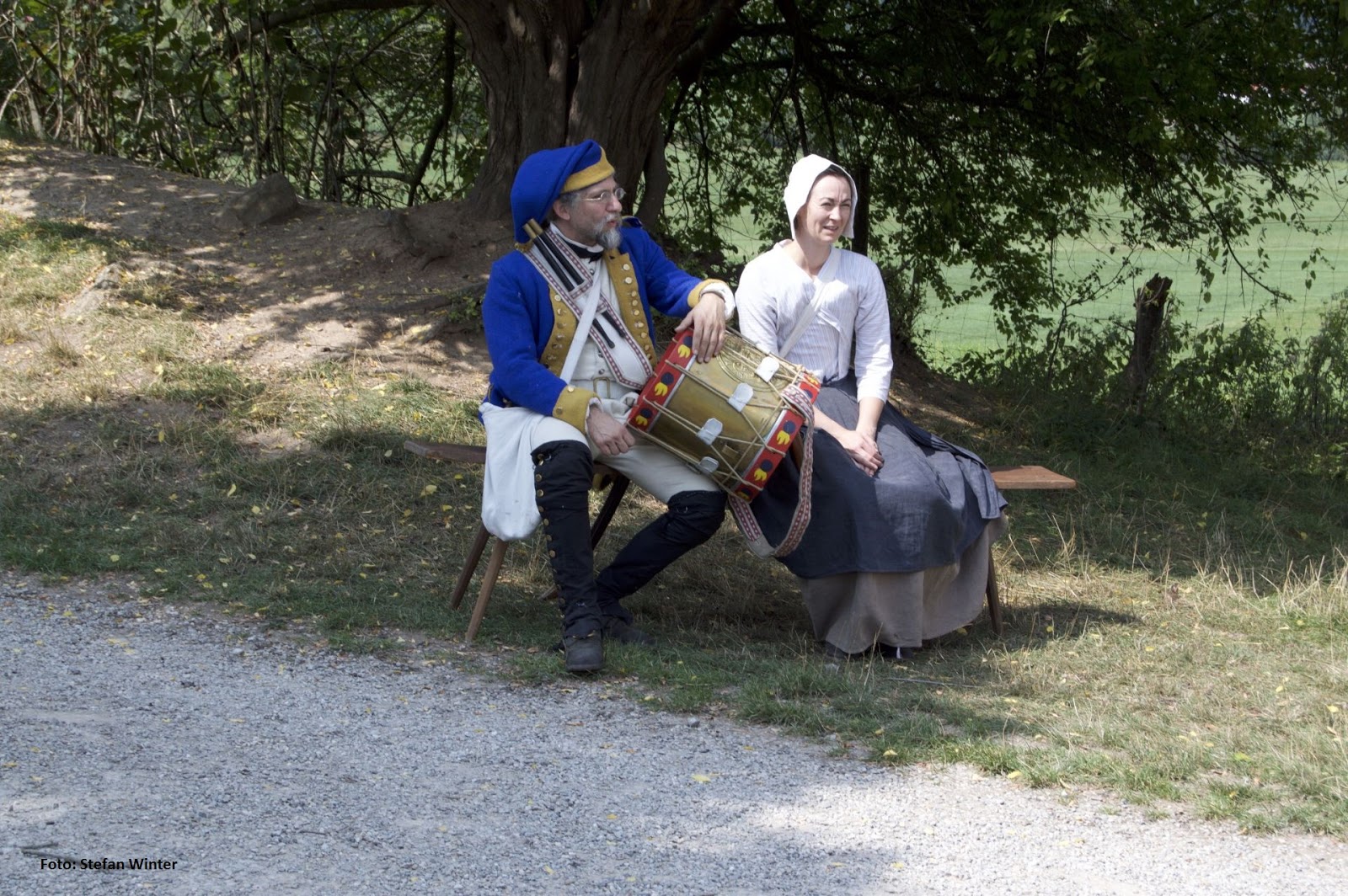
Der spanische Offizier von Maneze versuchte vor dem Steigengasthaus Soldaten zu werben. Der Schankknecht des Steigenwirts sah ja immerhin brauchbar aus. Maneze hatte einen Tambour dabei, welcher auch wirklich den einen oder anderen beinahe für die Sache gewonnen hätte, wenn dann nicht Maneze selbst auch die Härte des Dienstes offenbart hätte.

Gerade in dem Augenblick traf der Amtmann des Amtes Rosengarten ein, um weitere Versuche der Werber zu unterbinden. „Na, das glaube ich weniger!“ unterbrach der Amtmann den Offizier in der blauen Uniform, als dieser sagte, was er mit den Rekruten vorhatte. Es war ja ein kaiserliches Schreiben eingetroffen, welches die Werbungen unterbinden sollte.


Sind die Werber etwa beim Schankknecht erfolgreich? - Are they successfull with the waiter of the tavern? (Foto: Claudia Behnke)


Aber nein, der Amtmann ist da und hat einen Brief - but no, stop!, the Amtmann is there and has a letter (Foto: Claudia Behnke).
Major von Maneze nimmt verärgert das Schreiben entgegen - Major Maneze is upset (Foto: Claudia Behnke).


The scenario on Saturday was a bit speculative, but should demonstrate the problems of the ban of the Saxon-Hildburghausen or Spanish recruitment place.

The Spanish officer of Maneze tried to recruit soldiers in front of the tavern. The waiter of the innkeeper was looking useful. Maneze had a drummer, who was so successful to nearly get the waiter, although Maneze himself exposed the downsides of the military service.

Just at this moment the administrator of the district Rosengarten arrived to stop further tries by the recruiting officer. “I don’t believe that.” said the administrator to the officer, when he offered what he would do with the recruits. An imperial writing had arrived, which prohibited the recruitment.


Der Major und sein Trommler können es nicht glauben - the Major and his Drummer can't believe it (Foto: Claudia Behnke).


Der Trommler des Werbeofficiers - the drummer of the recruiting officer (Foto: Stefan Winter).

Nach einem üppigen Mahl im Steigengasthaus begab sich der Amtmann mit dem Grabenreiter zum Haus des Auswanderers, das an diesem Tage verkauft werden sollte.

Da ein höherer Verkaufspreis natürlich auch eine höhere Nachsteuer bedeutete, hatte der Amtmann ein Interesse daran den Preis für das Haus hoch zu halten. Der Schultheiß von Leoweiler, der eigentlich ein Haus brauchte, wollte nicht lange mitgehen. Zum Erstaunen der meisten Anwesenden aber überbot bald die Schultheißin von Michelfeld den Wirt von der Roten Steige. Der Amtmann wollte, dass das Häuschen für mindestens 300 Gulden verkauft wurde. Immerhin war das Dach in einem guten Zustand. Im hinteren Teil des Hauses war ein Zugang für Kleinvieh oder Hühner.


Der Amtmann kommt zum Haus des Andreas Juncker - the Administrator is arriving at the house of Andreas Juncker (Foto: Stefan Winter).
After a lush meal in the „Steigengasthaus“ the „Amtmann“ and his „Grabenreiter“ went to house of the emigrant, which was to be sold on that day.

A high price for the house effected that it would earn a high taxation and therefore the administrator had an interest to attain a high price. The Schultheiss of Leoweiler who needed a new house, didn’t wanted to pay a high price and was off soon. To the greatest surprise of most of the present countrymen the wife of the Schultheiss of Michelfeld started to bid more than the innkeeper of the “Red steep track”. The administrator wanted that the lodge would be sold for 300 florins at least. The roof was in a good condition. In the rear part of the house was an entry for goats or chickens.


Der Wirt will das Häuschen für seine eigenen Pläne - the innkeeper wants the small house for his own plans (Foto: Claudia Behnke).


Mittwoch, 18. September 2019

„Anno Domini 1769 – Von Hall in die Fremde“ - „Anno Domini 1769 from Hall into the foreign“ Teil 1 / Part 1


Ein Jahr ist wieder herum und wieder hatten wir eine Veranstaltung unserer Anno Domini-Reihe. Diesmal mit einem Thema, das wir noch nie behandelt hatten, nämlich der Auswanderung. Am Donnerstag traf ein überwiegender Teil unserer Teilnehmer planmäßig ein. Wie immer mein persönlicher Blick auf die Veranstaltung.


A year passed and we've had again an event of our Anno Domini-series. This time the object was something we never did: emigration. On Thursday most of our participants arrived as they planned. As always it’s my personal view on the event.


Am Freitagmorgen stand ich auf, um festzustellen, dass dichter Nebel über der Landschaft lag. Ich prüfte auf meinem Rückweg vom Steigengasthaus die Ähren und beschloss sie dennoch gleich nach dem Frühstück einzuholen. Dazu hatten wir ein kleines Wägelchen. Für die Heuernte waren damals eher große Leiterwagen mit Pferden im Gebrauch, aber bei manchen Arbeiten kamen auch so kleine Fahrzeuge zum Einsatz. Wir waren frisch gestärkt von dem köstlichen Musmehl, welches die Hausmutter und meine neue hervorragende Magd, Franziska, zubereitet hatten. Mit der Hilfe meines Nachbarn, Andreas Juncker, brachte ich das Getreide zu unserer Scheune. Hier wurde es durch uns drei Männer in dem Weiler gedroschen. Mein Knecht sah es leider garnicht so ungern, als ein Dreschflegel zu Bruch ging. Später am Tag wollten wir aus einem Stamm Schindeln herstellen, aber das Holz war zum einen zu feucht und zum anderen taugte der Kern nicht dazu. Es war am besten noch als Feuerholz zu gebrauchen, aber auch dazu ließ es sich kaum hacken.


Ich bringe mit meinem Nachbarn, dem Auswanderer, das Getreide ein - I bring home the grain together with my neighbour, the Emigrant (Foto: Stefan Winter).


On Friday morning I woke up to realize, that a sick fog was lying over the landscape. I examined on my return from the Steigengasthaus the ears of the grain and decided to catch them up after the breakfast nevertheless. We had a very small cart for that. Historically there were large hay carts in use, but sometimes they had small vehicles like this for some jobs. We were fresh and strengthened by the delicious Musmehl, which was prepared by the mother of the house and our excellent new maid named Franziska. With the help of my neighbour Andreas Juncker we brought the grain to the barn. Here it was flailed by us – 3 men. My farmhand unfortunately didn’t saw it grudgingly when a flail broke. Later that day we wanted to produce shingles from a tree trunk. But the wood was too wet and on top of that the core of the trunk was unusable. It was best to be used for the fire but even for that it was difficult to hack.

Montag, 1. Juli 2019

Mobilität im 18. Jh. (Teil 4) Unter fremden Flaggen – mobility during the 18th century (part 4) under foreign flags


Da wir in Teil 2 und 3 dargestellt haben, dass weder die Städter von Schwäbisch Hall scharenweise in ferne Gegenden des Erdballs aufbrachen noch die hällischen Untertanen auf dem Land, möchte man fast glauben, dass die Leute doch so ziemlich in ihrer Gegend blieben. Aber es gab eine große Ausnahme und das waren Soldaten. Schwäbisch Hall hatte außer in Kriegszeiten wie etwa im 7-jährigen Krieg nie Probleme ihr eigenes Kreiskontingent durch die Anwerbung von Freiwilligen zu füllen. Deswegen hatte der Rat der Stadt offenbar nichts dagegen, wenn Untertanen für ausländische Mächte Dienste annahmen.

As we did show in part 2 and 3, neither the citizens of Schwäbisch Hall left the town for far sides of the globe, nor the subjects in the countryside did so. We might believe, that the folks all more or less stayed in the region. But there was one great exception and that were soldiers. Schwäbisch Hall never had problems to recruit voluntaries for the own contingent of the Imperial circle except during wartime like the Seven years’ war.  Therefore the magistrate of the town obviously had no concerns, if subjects took service for foreign powers.


Besonders augenscheinlich wird das, wenn der Rat ständig ausländischen Werbern die Erlaubnis erteilte auf dem Land zu rekrutieren wie zahlreiche Einträge in den Ratsprotokollen belegen. Dies tat die Stadt obwohl die Kaiser ausländische Werbungen wiederholt verboten. Auf ein besonderes Beispiel werde ich detailliert eingehen. Das Prozedere war relativ einfach und wiederholte sich praktisch ständig. Es verging scheinbar kaum ein Monat, wenn sich nicht ein Offizier beim Rat einstellte, um die Genehmigung zur Werbung anzusuchen. Der Offizier wies sich beim Magistrat mit einem Schriftstück seines Souveräns aus. Dann musste er einen Vertrag[1] unterzeichnen, welcher ihm die Modalitäten der Werbung im Hällischen klar machte. Die Werber suchten vor allem Wirtshäuser und andere öffentliche Orte auf, um Freiwillige zu finden. Auch der Einsatz von Wein oder anderem Alkohol war obligatorisch. War der Werber nun erfolgreich und entsprach in seinem Verhalten dem Vertrag, so musste er mit dem Geworbenen vor dem Magistrat erscheinen und dieser genehmigte oder verbot die Mitnahme des Rekruten.
Es gibt aber auch Hinweise wie bei dem 1673 von Hohenlohe-Schillingsfürstischen Werbern geworbenen Hans David Hauschel, dass sich herausstellte, dass die Werber fragwürdige Methoden anwendeten und scheinbar den Geworbenen betrunken machten. Wegen der Unverantwortbarkeit des Vorgehens – Hauschel hätte seine Kinder und eine kranke Kindbetterin zurück gelassen – ging der Rat dann auch gegen diese Werbung vor[2].


That becomes very obvious, when the magistrate constantly was giving permissions to recruit in the countryside as many entries in the magistrate’s protocols verify. The town did that despite several emperors forbid foreign recruitment. I will focus on a special example later on. The procedure was relatively easy and repeated always. It seems that rarely a month passed without an officer who arrived in front of the magistrate with a document of his sovereign. Then he had to sign a contract, which clarified to him the modus of recruitment in the territory of Hall. The recruiting officers mostly went to taverns and other public places to find voluntaries. The use of vine and other alcohol was obligatory. When the recruiting officer was successful and his conduct was true to the contract, he had to appear in front of the magistrate and the magistrate allowed or forbid the take along of the recruit.
There were examples like that of Hans David Hauschel, who was enlisted by recruiters of Hohenlohe-Schillingsfürst in 1673, where the methods were questionable and the recruiters made the recruit completely drunken. The proceeding was absolutely inadequate, especially because Hauschel had children and a sick baby’s mother at home. Therefore the magistrate prevented the recruitment.

Seitenansicht einer preußischen Grenadiersmütze, 18. Jh. - sideview on a Prussian mitre cap (Foto: Cecilia Hanselmann, Burgmuseum Altena)
I have the impression that the cap is very low - is it actualy a grenadier's cap?

Hinteransicht der Mütze - backview of the cap (Foto: Cecilia Hanselmann, Burgmuseum Altena)
Frontalansicht der Mütze - frontal view of the cap (Foto: Cecilia Hanselmann, Burgmuseum Altena)

Mittwoch, 19. Juni 2019

Mobilität im 18. Jahrhundert (Teil 3) Auswanderung auf dem Land – mobility during the 18th century (part 3) emigration in the countryside


„Der Deutsche ist weder gedrückt genug – wenn man etwa die Pfalz und besonders den reformirten Theil der Pfalz, der wohl der grösste ist, ausnimmt – um sich den vielen Übeln, die eine jede Revolution zur Folge hat, unterziehen zu müssen …“ schrieb Reichardt in seinen Briefen 1792[1]. Tatsächlich lässt sich nach dem Deutschen Bauernkrieg feststellen, dass die Bauern im Hällischen mit der Herrschaft nie ernsthaft unzufrieden waren. Man hört nicht einmal etwas von "Aufruhr und Beschwerden"[2].

„The German is neither too much pressed – when we exclude the Palatine and especially the reformed portion, which is the biggest – to undergo the evils of a revolution …” wrote Reichardt in his letters in 1792. Indeed it is noticeable after the German Peasant’s war, the peasants in the territory of Hall were never earnestly dissatisfied with their rulers. You even don’t hear of "revolt or complaints".

Während um 1600 die Bauern Leibeigene waren, ging die Zahl der Leibeigenen danach zurück. Leibeigene durften allerdings ohne vorherige Aufhebung der Leibeigenschaft Bürger in einer anderen Stadt werden, auch wenn sie das in Hall selbst nicht durften[3]. Der Freikauf aus der Leibeigenschaft war für erst 20 dann 15 Gulden jederzeit möglich. Man hatte schon im späten 17. Jahrhundert, aber auch im frühen 18.Jahrhundert verstärkt darüber im beraten, ob man die Leibeigenschaft nicht ganz aufheben wolle, da sie als unrentabel galt und der Verwaltungsaufwand größer als der Nutzen schien[4].

In 1600 the peasants were serfs, but the number of them declined afterwards. Though the serfs could become citizen of another town without a previous abolition of the serfdom, however they could not do so in Hall itself. The ransoming from serfdom was always possible for 20 and later 15 florins. The rulers had debated during the late 17th and early 18th century about the complete abolition of serfdom, because it was noticed as unprofitable and the administrative expenses were bigger then the benefit.

Detail von Vier Montatsbildern, Tempera auf Leinwand, 2. Hälfte 17. Jh. - Detail from four month-pictures, Tempera on canvas, 2nd halve of 17th century (Hällisch-Fränkisches Museum, Foto: Kim Krawiec)