Dienstag, 3. Dezember 2019

Die Schlacht von Sablat 1619 - The battle of Sablat 1619

Diesmal will ich euch einmal einen anderen Zugang von mir zur Geschichte vorstellen. Wie schon vor einer Weile angemerkt betätige ich mich gelegentlich mit Tabletop. 
Für gewöhnlich geht dem Schreiben eines Szenarios für Spiele, die ich mit dem Regelwerk Honours of War durchführe, eine aufwändige Recherche voraus, die ich vielleicht an anderer Stelle näher beleuchten werden.

Today I want to present to you another access of mine to history. I mentioned before, that I occassionaly play tabletop.
Usually I'm used to put a lot of research in a scenario for a game using the Honours of War rules. I maybe will explain that aspect another time.

Diesmal hatte ich mir vorgenommen für die Schlacht von Sablat vorrangig die zeitgenössische Darstellung aus den Hogenbergschen Geschichtsblättern von um 1630 als Vorlage zu verwenden. 
Hier sei kurz angemerkt, dass Sablat eine Schlacht des Dreißigjährigen Krieges war, die mich mit als erste faszinierte, nämlich als vor nunmehr 21 Jahren im Fernsehen die Serie von Peter Milger "Gegen Land und Leute" lief. 

For this time I decided to use for the battle of Sablat particulary the contemporary illustration from the "Hogenberschen Geschichtsblättern from arount 1630. Here I want to point out, that Sablat was the battle of the Thirty Years war, which I was fascinated at most, namely when I saw 21 years ago the documantry series by Peter Milger: "Gegen Land und Leute" (Against land and people).

Mein Vorbild / My inspiration:
https://de.wikipedia.org/wiki/Schlacht_bei_Sablat#/media/Datei:Schlacht_von_Zablat_Hogenbersche_Geschichtsbl%C3%A4tter.JPG
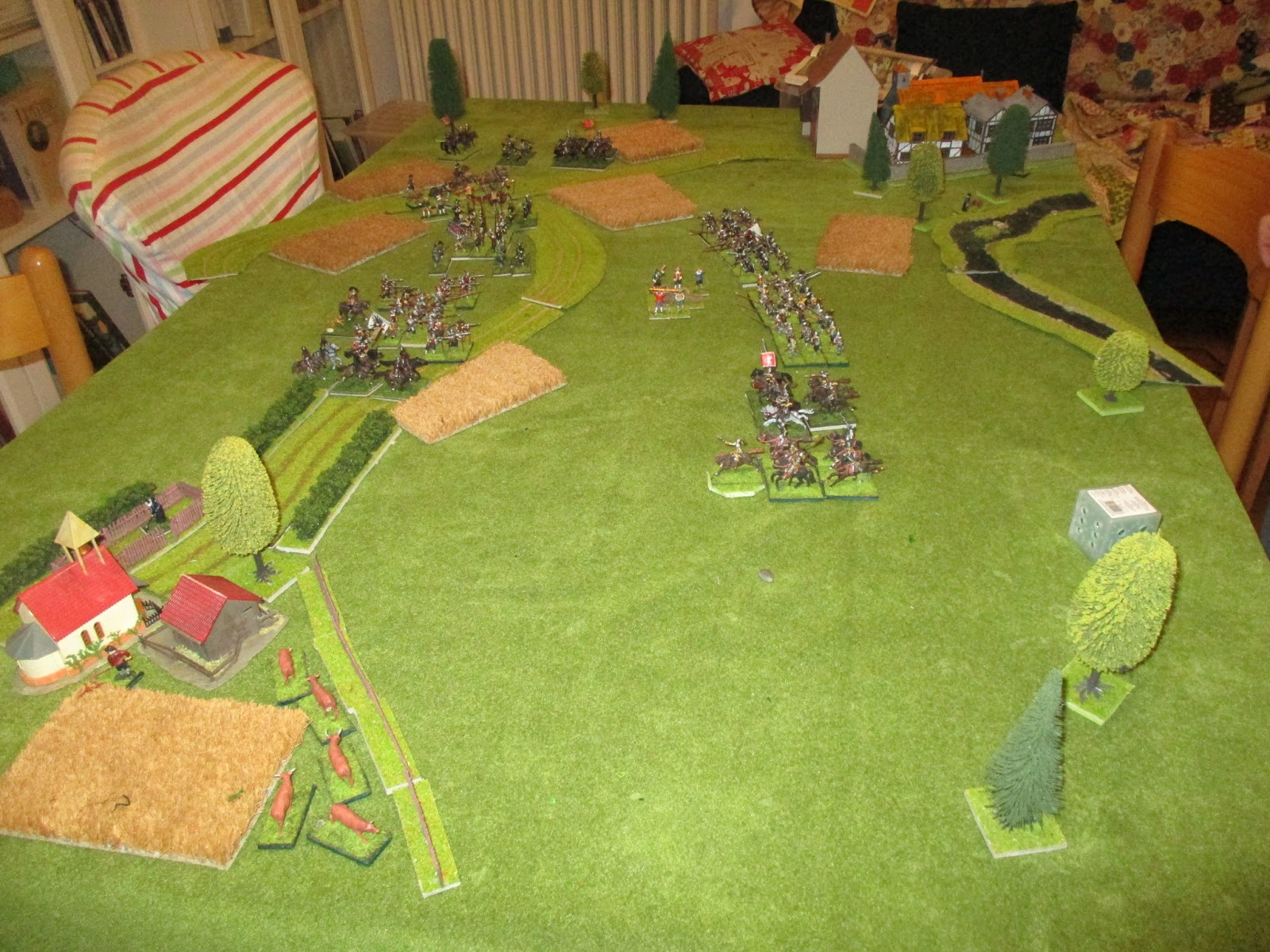
Beide Armeen aufmarschiert, links im Vordergrund Sablat, hinten rechts Rotelitz. Links das kaiserliche Heer des Grafen Buquoy mit Wallensteins Kürissern am linken Flügel und der rechtlichen Reiterei am Rechten. Rechts die Mansfelder mit dem Mansfeld selbst bei seiner Reiterei am linken Flügel, daran schließend sein Fußvolk.


Ich hatte mich für das Regelwerk Pikeman’s Lament von Michael Leck und Daniel Mersey entschieden, da ich damit schon recht vertraut bin. Ich habe damit bereits zwei Kampagnen bestritten. Für kleinere Schlachten scheint es mir bei kleineren Anpassungen noch brauchbar. Für sowas großes wie Höchst oder Wittstock würde ich andere Regeln verwenden. Später werde ich eine Ordre de Bataille für das Spiel wiedergeben. Die Wallensteinischen Kürassiere habe ich etwas reduziert widergegeben, damit die Mansfelder zumindest eine gewisse Chance haben. Mein Szenario setzt in dem Moment an, als Ernst von Mansfeld beschloss seine Truppen zurück zu ziehen. 3 Einheiten an Rotelitz vorbei in Sicherheit zu bringen ist daher neben dem Besiegen der Gegner das Szenarioziel der Mansfeldischen Seite, während die Kaiserlichen sie nur daran hindern brauchen. Mit drei geretteten Einheiten würde der Spieler des Mansfelders auch mehr erreichen als der historische Ernst von Mansfeld am 10. Juni 1619.


I had chosen Pikeman’s Lament by Michael Leck and Daniel Mersey, because I’m familiar with these rules. I had played two campaigns with them before. It seems that this set of rules is useful for small battles like that, if you try small amendments. I would use different rules for bigger battles like Höchst or Wittstock. Later I will describe my OOB. I reduced the size of Wallenstein’s cuirassiers to deliver some chance to Mansfeld’s side. My scenario starts in the moment, when Ernst of Mansfeld decided to retreat his troops. To pull back 3 units around Rotelitz in safety is the task for Mansfeld, except to defeat the enemy. The Imperials just have to prevent it. With 3 units in safety the player of Mansfeld would achieve more that the historical one on June 10th 1619.


Bemerkenswert an der Darstellung in den Geschichtsblättern ist, dass sie erheblich von der Beschreibung im Theatrum abweicht. Es wird keine Wagenburg oder dergleichen auf Mansfelder Seite gezeigt. Auch die Explosion bei den Mansfeldern taucht nicht auf, obwohl solche regelrecht obligatorisch auf zeitgenössischen Abbildungen wie bspw. der Schlacht bei Wimpfen (Matthäuse Merian 1635) und der Schlacht bei Lützen (Stich von Matthäus Merian, 1632) auftauchen. Vielmehr bilden die Geschichtsblätter eine Feldschlacht nach recht üblichem Muster mit zwei in Schlachtformation aufgestellten Armeen ab. Der Kampf um den Flecken Rotelitz wird ebenfalls weggelassen. Die Truppen Buqoys werden auch nicht als Ungarn etwa in ihrer ungarischen Kleidung dargestellt.


It’s remarkable, that the picture from the Geschichtsblätter differs much from the Theatrum. There’s no corral or something similar illustrated. The explosion is’nt depicted too, although that was downright obligatory on contemporary illustrations as for the battle of Wimpfen (engraving by Matthäus Merian 1635) or the battle of Lützen (engraving by Merian 1632).The “Geschichtsblätter” rather depicted the battle as a common encounter with two armies formed in battle lines. The fighting around the market town of Rotelitz was omitted too. Bucoy's troops were for example not shown in their typical hungarian garements.

30 Mansfelder Musketiere lagen im Flecken Rotelitz - 30 of Mansfeld's musketeers were put in the market town Rotelitz.

Ein Teil der Einwohner war bewaffnet, was ihnen in dem historischen Gefecht zum Verhängnis wurde, so das Theatrum - some of the inhabitants were armed, which caused their doom during the historical encounter, as the Theatrum told.

Wer mag, kann ab hier einen Spielbericht unserer Partie lesen.


You can read a report of the game here if you wish.


Montag, 18. November 2019

"Zwingli - Der Reformator" / "Zwingli" (2019)


Schweiz/Swiss, 2019, Regie/Director: Stefan Haupt


(Text in English below)


Wie schon angekündigt wird es hier immer mal wieder, wenn es sich anbietet Filmrezensionen geben, falls der Film zu einer unserer Veranstaltungen passt und auch irgendwie etwas über die Geschichte vermitteln soll. „Die Nonne“ (Regie: Guillaume Nicloux, 2013) würde da beispielsweise hinein passen, „Porträt einer jungen Frau in Flammen“ (Regie: Céline Sciamma, 2019) m.E. nicht.

Besonders stark hat mich in letzter Zeit die Auseinandersetzung von Brandon F. auf seinem Youtube-Kanal über den Film „Culloden“ (1964) von Peter Watkins geprägt. Hier unterstrich Brandon F. gekonnt wie ein Film, der in zahlreichen Ausstattungsdetails vielleicht daneben liegt, doch in seinem Ausdruck authentische Eindrücke vermitteln kann.

Warum aber nun „Zwingli – Der Reformator“? Zwingli war eine der entscheidenden Figuren der Reformation im deutschsprachigen Raum. Ebenso wie der Haller Pfarrer Brenz stand auch Zwingli im Kontakt mit Luther und prägte das sogenannte konfessionelle Zeitalter – die Zeit der Reformation bis weit ins 17. Jahrhundert. Die reformierte Bewegung hat in Deutschland erhebliche Spuren hinterlassen und mit dem Übergang der pfälzischen und brandenburgischen Kurfürsten Friedrich III., der Fromme (1515-1576), und Johann Sigismund (1572-1620) teilweise selbst zu einer Entfremdung der Herrscherhäuser gegenüber den von den Landesherren zum lutherischen Bekenntnis geführten Untertanen geführt. In Schwäbisch Hall gab es ähnlich wie in Sachsen unter Christian I. und Christian II. den Versuch das reformierte Bekenntnis durchzusetzen, welches in den Schnecken’schen Unruhen Anfang des 17. Jahrhunderts gipfelte[1].

Ein kleiner persönlicher Grund mag sein, dass ich selbst in einer Produktion des Regisseurs Peter Prestel schon als ein Reformator, nämlich als Johannes Brenz aufgetreten bin.

Wie würde die Schweizer Produktion also schaffen das Leben des bedeutenden Theologen Huldrych Zwingli (1484-1531) widerzugeben?


Die Handlung erstreckt sich von Zwinglis (Max Simonieschek) Eintreffen in Zürich 1519 bis kurz nach seinem Tod in der Schlacht bei Kappel am Albis 1531. Von Anfang an schlägt Zwingli die Skepsis vieler Zürcher entgegen, da er die Bibel auf Deutsch vortragen und erläutern will. Sofort begegnet er der Witwe Anna Reinhart (Sarah Sophia Meyer). Diese empfindet erst ein Zutrauen zu Zwingli als dieser die Stadt anders als die anderen Geistlichen nicht wegen einer Pestepidemie verlässt, sondern weiterhin den Menschen Trost spendet. Das Wurstessen bei Froschauer (Philipp Stengele) wird zu einem Schlüsselereignis, als sich der Rat unter Führung des Bürgermeisters Röist (Stefan Kurt) dagegen verwahrt gegen Zwingli, der nur anwesend war aber nicht mitaß, vorzugehen. Die Disputation mit Zwingli und seinen Anhängern auf der einen und Johann Faber (Oscar Bingisser) und den katholischen Chorherren um Hofmann (Andrea Zogg) auf der anderen Seite verläuft zu Gunsten Zwinglis und der Rat erklärt sich für den Reformator. Im Mittelpunkt des Films aber steht Zwinglis Verhältnis zu Anna Reinhart, die eine Beziehung mit Zwingli beginnt und unter Druck gerät, als sie von ihm schwanger wird, während Zwingli noch versucht vom Konstanzer Bischof die Erlaubnis zur Ehe zu erlangen. Doch dieser Bischof (Ueli Jäggi) wird bald zum erklärten Gegner Zwinglis, der es unterdessen mit den radikaleren Wiedertäufern um Felix Manz (Michael Finger) zu tun bekommt, der schließlich ertränkt wird. Als der Bischof Verbündete für einen Krieg gegen Zürich um sich schart, versucht auch Zwingli durch einen Ausgleich mit Luther Städte in Deutschland und in Verhandlungen Basel, Bern und andere eidgenössische Städte für sich zu gewinnen. Doch letztlich müssen die Zürcher allein in die Schlacht ziehen aus der ihr Reformator und  Annas ältester Sohn nicht zurückkehren sollen.


Funktioniert „Zwingli – Der Reformator“ als Film? Ja, ich denke schon. Der Film ist auch ohne internationale Stars durchaus auf Augenhöhe mit „Luther“ (2003), der mit Joseph Fiennes, Alfred Molina und Peter Ustinov auf ein Spitzenensemble bauen konnte.

Das Problem ist bei jeder Verfilmung einer solchen Biographie, dass die Handlung nicht in endlosen theologischen Debatten erstirbt. Die Disputation Zwinglis mit Manz wurde daher wohl komplett weggelassen bzw. auf eine persönliche Aussprache reduziert.

Ein großes Problem ist wohl, dass der Aufwand eines Historienfilms für die Schweizer Produktion etwas zu viel war. So bekommt man praktisch keinerlei Schauwerte zu sehen. Alles womit der Film optisch zu punkten versucht ist eine PC-Animation Zürichs von einer Seite. Sonst spielt der Film entweder in engen Gassen, der Kirche oder Innenräumen. Gerade als am Ende vom Kriegszug die Rede ist, bekommt man keinen Eindruck von dem Ereignis. Man sieht eine Marschsäule und das war es.
Die Ausstattung ist leider doch sehr mau. Die Kostüme der meisten Figuren bestehen aus einem eigenwilligen Mix aus Tuch und Leder. Aaaah! Verschiedene Experten im Netz haben schon darauf hingewiesen wie es doch stört, wenn Kleidung oder Rüstungen einfach keinen Sinn ergeben. So auch hier mit Kleidungsstücken der Leute auf der Straße, die mit Hanfschnüren irgendwie zusammengehalten wird. Warum aber tragen fast alle Charaktere eine Farbpalette von Grau oder Braun? Hat noch niemand die Farbigkeit der spätmittelalterlichen Kleidung registriert? Und wenn man von Söldnern spricht, warum sieht man denn keine? Keiner der Soldaten im Film sieht irgendwie aus wie ein Schweizer Reisläufer[2]. Warum hat Zwinglis Gattin nur ein „Kleid“? Warum laufen viele im Winter hemdsärmelig rum? Hätte man auf die Reenactmentszene in der Schweiz zurückgegriffen wie einige Dokuformate mittlerweile in Deutschland, wäre der Film optisch sicherlich ansprechender geworden. Ganz zu schweigen von dem Vorteil, dass die Kleidung einfach authentischer gewirkt hätte.


Was mich aber wohl am meisten störte war, dass laufende „Hallo!“. Natürlich muss man nicht gestelzt versuchen die Sprache von damals zu verwenden, wenn das dann kein Zuschauer versteht. Aber wenn die Charaktere immer „Hallo!“ rufen, ist das doch irgendwie arg anachronistisch.


 Ein Pluspunkt liegt meines Erachtens bei den Schauspielern. Max Simonieschek macht seine Sache ganz gut und auch Sarah Sophia Meyer schafft es behutsam in ihrer Rolle zu überzeugen. Einzig die Gegenspieler fand ich etwas arg blass, was aber auch an den farblosen Szenen lag, die sie bekamen. Das hat man einfach schon hundertmal gesehen, dass die fiesen Schurken fressend oder saufend nebenbei die Entscheidungen treffen. Man merkt einfach nicht, dass dem Bischof und seinem Gefolgsmann Faber die Gefahr bewusst wird, die da auf sie zukommt.
Insgesamt ist „Zwingli – Der Reformator“ eine solide Arbeit ohne tiefere Einblicke zu gewähren. Ganz selten kommen Momente des Zweifelns auf, aber es gibt eigentlich kaum innere Konflikte oder Entwicklungen der Figuren, was dem Film doch die Spannung nimmt. Die Beziehung Zwinglis zu Anna ist einfach nicht tragfähig für einen Spannungsbogen. In Deutschland wäre der Film wohl als TV-Produktion durchgegangen. In der Schweiz zählt er zu den 20 erfolgreichsten Filmen der letzten 40 Jahre[3]. Man kann es sich anschauen. Vor allem, wenn man keine Ahnung von der Schweizer Reformation hat, bekommt man vielleicht einen Impuls sich näher mit der Person Zwinglis und seiner Mitstreiter zu beschäftigen.

 
Plakat am Friedrichsbau Kino in Freiburg.


As I had mentioned before, we will post here occasionally some reviews of actual films, if they have some connection with our events and if they reflect some interesting history. “La Religieuse” (d: Guillaume Nicloux, 2013) for example would fit into the frame and “Portrait de la jeune fille en feu” (d: Céline Sciamma, 2019) imho would not.

The reflections of Brandon F. on his youtube-channel about Peter Watkin’s “Culodden” (1964) impressed me very much. Brandon F. managed perfectly to underline the authentic impact of the film, even when the equipment in many parts was not authentic.

But why “Zwingli”? Zwingli was one of the leading figures of the reformation in the German speaking area. He had communication with Luther like Johannes Brenz , the pastor of Hall did, and shaped the age of confessionalization – the time just into the 17th century. The Swiss reformation movement had left vastly traces in Germany. The conversion of the Palatine and Brandenburg electors Frederick III, the Pious (1515-1576), and Johann Sigismund (1572-1620) effected some sort of alienation of the rulers to their Lutheran subjects which where before led by them into the reformation. Comparable like in Saxony under the electors Christian I. and Christian II., there was an attempt to introduce the Calvinist confession in Schwäbisch Hall, which concluded in the Schnecken-riots during the beginning of the 17th century.

A small personal reason is that I acted as the reformer Johannes Brenz in a production by the director Peter Prestel.

How would the Swiss production manage to reflect the life of the important theologian Huldrych Zwingli (1484-1531)?
 

Dienstag, 12. November 2019

Ausblicke / Prospects


Dieses Jahr haben wir soviele Beiträge hier im Blog online gesetzt wie noch nie. Mit der Reihe zur Belagerung Freiburgs sind wir sogar einmal etwas andere Wege beschritten – eine längere Serie, die systematischer aufgebaut war. 

This year we had put so many posts on that blog like never before. We adopted particular tracks with our series about the siege of Freiburg (although in the timeframe of our “Anno Domini 1743”-event in 2018) – a longer series which was constructed systematically.


Der Zuspruch auf verschiedenen Ebenen, mein Dank geht hier an alle, die sich bei mir gemeldet haben (zum Beispiel nach Griechenland), hat dazu beigetragen, dass es ähnliches wie zur Schlacht bei Simbach und zur Belagerung von Freiburg[1] wieder geben wird.

I want to thank for all encouragement from different sides (for example from Greece). That encouragement convinced me that I will continue to write about topics like the battle of Simbach or the siege of Freiburg.

Vielleicht machen wir sogar ein paar Rezensionen zu Film und Fernsehen bzw. Büchern, wenn es für das Anliegen des Blogs - Einblicke zum historischen Hintergrund unserer Veranstaltungen zu gewinnen – Sinn ergibt.

Perhaps we will write even some reviews about films or TV respectively books, if it makes sense for the issue of our blog – to give insights in the historical background of our events.


Ich würde gern mehr dazu schreiben was mein Motivator ist, was mich dazu inspiriert immer mehr zu recherchieren. Was nutzt mir beispielsweise das Hobby Wargaming? Wie stößt man dabei auf spannende Quellen?


Unser Tisch mit dem Szenario der Gefechte bei Auenheim und Suffelnheim am Abend des 23. August 1744 - Our table for the encounters at Suffelnheim and Auenheim on the evening of August 23rd 1744 (Foto 2019).

I would like to write more about my motivation to research. Is the wargaming hobby usefull perhaps? How it is possible to come across exciting sources?


Ein anderes interessantes Themenfeld ist – was machen wir außerhalb unserer beiden Veranstaltungen noch im Bereich des Living History? Unser Beitrag zur Schwarzwaldwanderung war da ein kleiner Einblick. Ganz selten haben wir aber auch Zeit tatsächlich Veranstaltungen anderer Organisatoren zu besuchen. Besonders herauszuheben sind hier die der Gruppe Les Soirées Amusantes (www.lessoireesamusantes.com), die wie wir viel in Museen machen, aber auch private Treffen veranstalten wie wir das früher vor allem im Barockschloss Zeilitzheim getan haben.

Wir sind zusammen mit einer Freundin auf einem Event von Les Soirées Amüsantes in Basel im Haus zum Kirschgarten - we are together with a friend at an event of Les Soirées Amüsantes at Basel in the "Haus zum Kirschgarten" Museum. (Foto 2019)
Another interesting topic is – what we are doing except our two events in the Living History hobby? Our post about our trip in the Black Forrest delivers a small impression. Very rarely we have time to join events of other organizers. I want to mention especially the group “Les Soirées Amusantes” (www.lessoireesamusantes.com) which is organizing mostly in museums just like we do, but have private events too as we did previously in the Baroque castle Zeilitzheim.


Es ist natürlich für den Leser und auch nicht zuletzt unsere Teilnehmer der künftigen Landleben- oder Anno Domini-Veranstaltungen interessant, was wir derzeit so machen. Ich selber bin wohl für die nächsten 2 Monate mit dem Sichten der hunderten Seiten beschäftigt, die wir im Stadtarchiv aufgenommen haben. Die Jahre 1620 beziehungsweise 1749 stehen dabei im Mittelpunkt.
Es wird ganz spannend wie sich die Zuspitzung des 30-jährigen Krieges auf die Reichsstadt auswirkt.
Zum anderen werden wir nächstes Jahr wieder auf das Jahr 1749 und die Auswirkungen des Konfliktes von Schwäbisch Hall mit dem Ritterstift Comburg treffen. Dazu gibt es unzählige neue Quellen, die wir gefunden haben.


Donnerstag, 31. Oktober 2019

The siege of Freiburg in 1744 (part 5)


Today I ask myself for what the French fought and captured the town? Perhaps the death of Charles VII changed all the French plans. Theoretically the town was sawn as a part of Charles heritage and he had the chance to get a fine fortress. But very fast the French decided to not stay in Freiburg but to destroy the fortress at the hill and the town’s fortifications mostly planed by the French engineer-genius Vauban. Even today visitors can see the remnants of the craters of the French demolitions at the fortress.

Large contemporary bomb in the Museum of the town "Museum für Stadtgeschichte" in the Wentzingerhaus, Freiburg.
Photo from 2018.
The remnants of the Pulverturm (powdertower) near the Schwabentorbrücke. Note the depth of the trench even today.
Photo from 2018.


Modern archaeologists from the Regierungspräsidium Freiburg discover more and more about the condition of the fortress and the results of the latest detections are impressing. The trenches of the city walls had a depth of 12 meters and enormous walls. The archaeologists are finding more and more always when new buildings were raised in the old town for example for the students of the university. Some of the hand-grenades used during the sieges can be seen at the museum of the town in the Wentzingerhaus. Dr. Bertram Jenisch (archaeologist from Freiburg, RP Freiburg) assured the audience at an important colloquium[1] about the warfare in Southwestern Germany that more finds would be presented to the public soon.


A view on the trenches of the "Franzosenschanze" (French redoubt) built in 1744.
Photo from 2018.
Even today it’s not too difficult to find relicts from the great siege in 1744. I visited the “Franzosenschanze” near the Kybfelsen-area for several times. This redoubt was built during the siege by the French and is laid out opposite of the fortress on around the same level like the fort. Many contemporary maps show dozens of such redoubts built by the besiegers.
The entrance of the Franzosenschanze.
Photo from 2018.

Inside the redoubt. Note the Level of the wall of the redoubt at the right. Maybe that was the Level during the siege. I'm not sure about the function of the small redoubt, which was typical for the period and can be found on the contemporary maps of the siege, which Show many of such redoubts on that side of the Dreisam-valley.
Photo from 2018.
One of the main objectives was to blockade the Dreisam-valley to stop Austrian reinforcements (the Austrian high command never ordered any reinforcements to save Damnitz).


That is the end of my series about the siege of Freiburg. Please feel free to write a comment. Do you want more posts of that style?
I want to thank my wife and my kids, who were so kind to help me visiting all the places, which would have been very boring without them.


Text: André Hanselmann
Photos: André & Cecilia Hanselmann


[1] Dr. Bertram Jenisch. „Archäologische Spuren von Festungen im rechtsrheinischen Oberrheingebiet“ at the colloquium by the Alemannisches Institut and the Landesamt für Denkmalpflege „Im Krieg ist weder Glück noch Stern“ Friday 15th of june 2018, at Breisach

Freitag, 25. Oktober 2019

The siege of Freiburg in 1744 (part 4)


Some original cannonballs in the collection of the "Museum für Stadtgeschichte" Freiburg
The "communication", a walled way from the Oberschloss and Fort Carré to the Salzbüchsle. Narrow but plenty of space to move the guns from one section of the fortress to the other. The Austrians had frequently to replace their destroyed guns, which were shot by the French siege artillery. In late October 1744 however most of the Austrian guns on the fortress were silenced.
A contemporary drawing of the "communication" above on a modern plaque on the Schlossberg.


Freiburg still was a cracking nut and the heavy fighting with outbreaks on 13th and 14th of October showed the attackers that the defenders was determined to fight.

A drawing of the Salzbüchsle by the comte de la Venerie in 1723/28.
The Salzbüchsle was one of the sections which were extended after the siege during the War of the Spanish Succession.
From a plaque on the Schlossberg in 2018.
A second "communication" which connected the Salzbüchsle with the Unterschloss. In that area the visitor still can find many of the explosion craters from the final French destruction of the fortress in 1745.
The size of the kids elucidade the width of the "communication" which was crucial for the reinforcements at the Unterschloss.

The Austrians celebrated the saint’s day of their female monarch on October 15th but the saluting gunnery was silenced by heavy French artillery fire in minutes. After heavy fighting at the ravelins and the Kaiser-Bastion and in front of the Martinstor the French had shot many breaches in the walls.

Above a contemporary pistol with bullets. beneath some original Hand grenades from 1744 in the collection of the "Museum für Stadtgeschichte" Freiburg.


But the brutal fighting at walls lasted under the eyes of the French king the 2nd halve of October. The Austrians and French fought with great fury with bayonets and grenades. Some citizens wrote about the fighting at the 2nd of November around the Kaiser-Bastion and two ravelins:

“… There was no shot of a musket to hear… It became 3 o’clock in the morning when the French used the raining weather to advance in silence. Easily they captured the first ravelin with storm ladders and overwhelmed the outposts. Captain Wurzer had manned the post with 40 men and withdraws the soldiers in the guardroom. The muskets put in front of the guardroom were taken by the enemy; the captain had to surrender with his men…”  
To take the second ravelin through the muddy trench was a lot more difficult. But the French were motivated after the surprise attack at the first:


“… But here the sentry was more cautious and gave fire immediately. There was only a post of 100 men at the wall, but fortunately they were reinforced at the moment by the replacement. The gallery was a strong obstacle for the enemy too. The deeper the silence was, so louder were now the cries: “Avance, avance, vive le roi!””[1]

Detail of the large Diorama of the town and fortress in the "Museum für Stadtgeschichte" Freiburg.
Note, the high near the river which is the Schwabentor, where Leutnant Fetzer attacked the French.
At the right side the large ravelins attacked by the French in late October and early November 1744.

Montag, 21. Oktober 2019

The siege of Freiburg in 1744 (part 3)


A painting by Pierre Nicolas Lenfant shows us a somehow idealized situation[1]. The king himself who visited the siege more as a spectator then as a commander wears his red dress, well known from different battle paintings by Parocel and Lenfant. (Look at the painting in the collection of Versailles: http://collections.chateauversailles.fr/#26dc20ed-9a28-43c2-ae71-9e72a84ef01b ) He is talking to some officers and generals and his position is characterized by the Loretto-chapel at the left of the painting. The guns are bombarding the town and the Austrian artillery answers the fire. What Lenfant paints is a mixed bag. The artillery is firing but the river Dreisam still is in the old riverbed in front of the town’s walls, which are partly destroyed already. The buildings at the Schlossberg are completely arising of the painter’s fantasy – you just have to compare them with historical maps. The most important features of the fortress like the “Salzbüchsle” or “Fort Aigle” (as the French called it) which were heavily modified in the 1720s after the lesson the Austrians learned from the 1713-siege, looked completely different. But for some studies of French camp-life, uniforms and the French view on the siege this painting really is interesting. The painter gave the landscape a more romantic atmosphere with rocky hillsides and nice exotic looking trees while in this period the hillsides were covered with vines.

The king's view at the town from the Lorettoberg.

The Loretto-chapel today.


The presence of the king was in fact of no great significance for the battle itself. In many biographies of Louis XV it is mentioned in a foot note at the most because his recreation from his serious illness in 1744 is of more importance for the outcome of the war than the siege of Freiburg. Bernier[2] gives a good impression of the character of the “bien aimé”, a better picture for sure then Reed Browning, although his book about the war is highly readable[3]. The king had his headquarters at Munzingen in the same castle where prince Charles of Lorraine stayed at the time of his attempts to cross the Rhine at Breisach in 1743. All sources mention that he observed the siege from the Lorettoberg. There was an agreement that the French would not bombard at the minster of Freiburg, if the Austrians would not shoot at the position of the French king. But it seems that the Austrians shot in his direction nevertheless because it’s possible to find a cannonball even today near his place of observation[4].

The canonball in the wall of the Loretto-chapel - although in my opinion neighter the caliber nor the place of the canonball make sense to me.
An indiscription at the Loretto-chapel mentioning the presence of king Louis XV observing the siege from that Point in 1744.
The inscription mentions the battle of 1644 too. The chapel was built in 1657 in memory of the bloody battle during the 30-years war.


Naturally Louis XV didn’t come to share the bloody warfare with his soldiers and for sure he didn’t share the heavy work of thousands of French peasants who were brought to Freiburg to build a new riverbed for the Dreisam. The king himself showed not much affection to stay until the town was won. He departed with his entourage at the morning of the 7th November shortly before the French troops entered the town.


A view from the place of the Salzbüchsle, where nowadays is a modern tower, on the landscape.
Please note the two small hills in the middle distance. The lower one is the Lorettoberg, the position of the French king in 1744.


Text: André Hanselmann
Photos: André Hanselmann


[1] Pierre Nicolas Lenfant: „Siège de Fribourg, 11 octobre 1744“ at the château de Versailles, No. d’invitaire MV 187
[2] Olivier Bernier: „Ludwig XV. – Eine Biographie“ Benzinger, Zürich, 1986
[3] Reed Browning: „The War of the Austrian Succession“ St. Martin's Press, New York, 2008
[4] Tilman Spreckelsen: „Patenschaft fürs Kirchenschiff“ Die Zeit, 10. September, 1998

Sonntag, 20. Oktober 2019

The siege of Freiburg in 1744 (part 2)


It’s very interesting that hussars and light infantry played a major role in the defence of the town, although they had just 8 companies of light infantry and 300 hussars only as a part of the garrison which was around 6.500 men strong[1]. The commander in chief, FML Damnitz, was an experienced soldier who was not such a sort of town’s commanders, who saw little action in the open field. The French army was a mighty force of 66 battalions and 117 squadrons, although the cavalry was reduced later because there was not enough of fodder for the horses[2]. But for the first stages of the siege a large cavalry force was crucial for the encirclement of a besieged town.


A picture of the whole fortress at the Schlossberg. At the left: the Oberschloss or Fort St. Pierre with the "Große Hornwerk"; in the middle the Fort Carré (the lodgings of the commander of the fortress); at the right: the Unterschloss. The Unterschloss formerly was the old castle of Freiburg in the middle-ages.
At one of the plaques on the Schlossberg in 2018.


The Austrians launched some more outbreaks with modest success, destroying some of the work of the French engineers and setting a great stock of wood at the hillside of the Schlossberg in fire. The outbreak in the twilight of October 14th is especially interesting. The Austrians had 30 "Theisser" and 40 grenadiers under the command of Lieutenant Fetzer to attack a redoubt opposing the Schwabentor. The Austrians not only managed to destroy parts of the French earthworks and take away Tools, but the French lost the engineer Marquis d'Aversnes and the Maréchal de Camp de Coutomer killed too during the action.

But the light troops played not only a major role in these events but as feared robbers of the poor citizens of Freiburg too. The pandours and Theisser used the chaos of the bombardment which set a large part of the town in fire. When Damnitz heard the accusation of the citizens against his light troops, he convicted some of them to death, but the citizens pleaded him to show mercy. Besides Damnitz had raise up gallows at the Fischmarkt before the battle to demonstrate his earnestness to keep discipline and order in the citizenship.

A model of a French 16-pounder gun (in the middle of the photo) by Imperial (Hagen Figuren).


The famous French artilleryman de la Vallière (best known for the Vallière-system) was present at the siege and advised Coigny to not start with the bombardment before every gun was ready. But Coigny ignored the advice and if he was right or not, the result of the bombardment was devastating, not only destroying many civilian houses but the house of the commander – known as the fort carré – too. Soon it was clear that the positions of the French batteries in 1744 were a lot more effective than during the siege of 1713. Now the French guns could nearly not miss the target and could destroy huge parts of the fortress in a short time.

Text: André Hanselmann
Photos: André Hanselmann
Fort Saint Pierre today. At the left formerly the wall with Palisade, than a trench and at the right the place, where the barracks of the fort Saint Pierre stood.


The place of the chapel St Pierre marked by a wooden cross.


[1] Porges/Rebrachta p. 530
[2] Porges/Rebrachta p. 533